
Simplification and Burden Reduction
Effective regulation is essential to investor protection and financial stability, but also to the attractiveness of EU markets. Simplifying and reducing burden can ensure that rules deliver their objectives without unnecessary complexity or administrative cost. In this context, ESMA aims to make the regulatory framework more streamlined, cost-efficient and easier to use by:
- simplifying regulatory and supervisory requirements,
- making rules more proportionate to entities’ size, nature and risk,
- improving consistency and usability of its work.
ESMA’s approach
Simplification and Burden Reduction is considered across ESMA’s full range of responsibilities, including rulemaking, supervision, data strategy and cultural change.

Regulatory framework: Based on identification of areas where there is room to simplify, ESMA prioritises the items of the policy framework where burden reduction could bring the greatest benefits.

Supervisory approach: Developing and rolling out risk and outcome-based principles aiming at a lean supervisory approach for entities across the EU supervisory structure.

Data strategy: Targeting data efficiency and increased data use by reducing duplication, expanding standardisation and applying emerging technologies.
Impact and benefits

ESMA’s flagship initiatives at a glance
ESMA has decided to firstly concentrating efforts on a few flagship topics that they present opportunities for substantial burden reduction in areas of key relevance to the objectives behind the EU’s push to increase EU’s competitiveness.
 |
Transaction reportingFirms should be able to report once. ESMA aims to streamline transaction reporting requirements across MiFIR, EMIR and SFTR, by developing common solutions building on instrument-based and dual-side simplifications. In the longer term, this should leading to a “report once” framework. The final recommendations have been published in July 2026 including a comprehensive cost benefit analysis. For more information, please consult the factsheet available here. |
 |
Integrated funds reportingAsset managers should have harmonised reporting templates. This single reporting template for UCITS and AIFMD will be designed to remain proportionate for different fund sizes and investment strategies, while meeting supervisory needs. ESMA envisages a hybrid model that includes data validation, storage and analytics at EU level, while keeping data collection at national level. The centralised hub will offer efficiency and will limit duplicative data requests, by facilitating data sharing across authorities. The technical standards will be developed in 2027, to be followed by a phased-in implementation. |
 |
Investor journeyIt should be easy for retail investors to access suitable investment opportunities. ESMA has outlined a set of actions and operational improvements in three areas to make it easier for retail investors to access investment opportunities: - streamlining disclosure requirements and tackling information overload for investors, This action will contribute to eliminating unnecessary obstacles retail investors face when engaging in capital markets. ESMA will work on these improvements in alignment with the upcoming work on the Retail Investment Strategy. |
 |
Risk-based supervisionFocused, and high-quality EU supervision supports simplification and boost efficiency. Risk-based supervision (RBS) is a cornerstone of functioning markets in the EU and enables simplification by boosting efficiency and value. With these Principles attention focuses on key risks, reducing unnecessary burden and activities, while preserving supervisory soundness. ESMA is in the process of securing implementation of the RBS principles across ESMA and national authorities. |
Timeline (2024–2027)
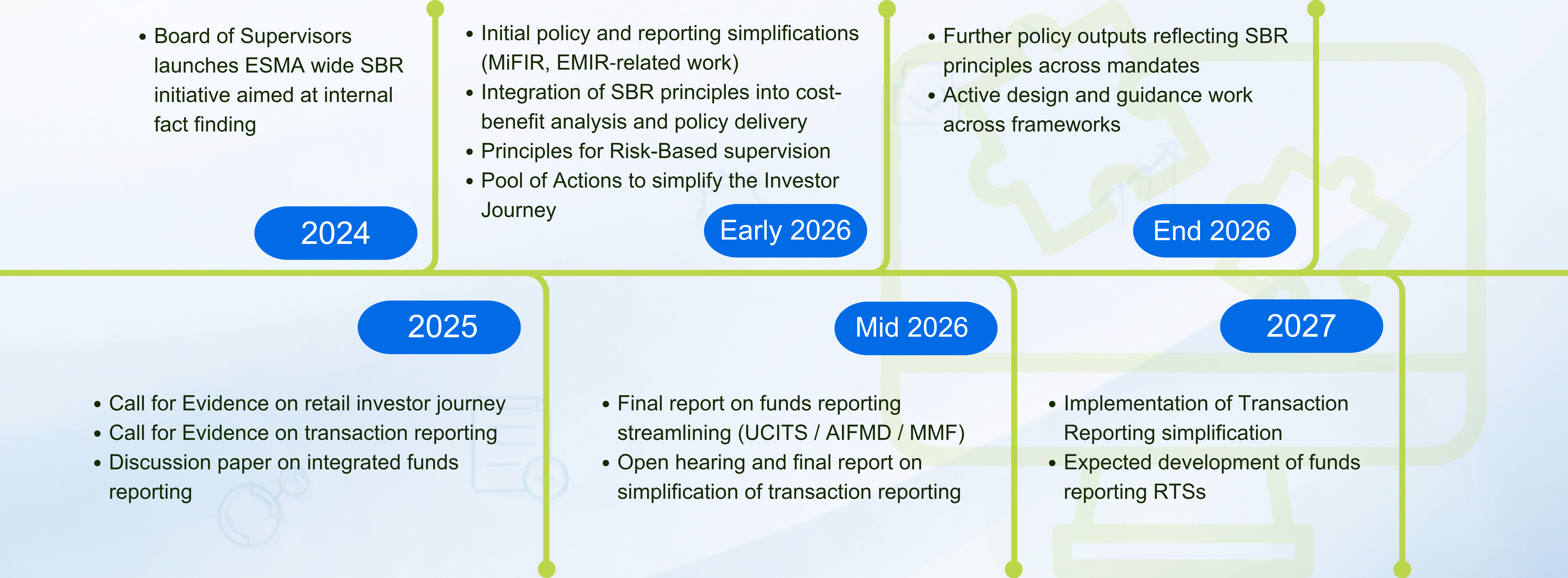
* Key milestones of ESMA’s simplification and burden reduction work
SBR actions across ESMA’s remit
Beyond flagship initiatives, ESMA reviews regulatory technical standards, guidelines and other regulatory measures to identify opportunities for simplification.
Markets and infrastructures
Listing Act: Simple and straight-forward rules for admission to public trading
- The Listing Act simplifies the rules for companies seeking admission to trading on public stock exchanges, countering fragmentation of national laws that restrict the flexibility of companies to issue multiple-vote shares when going public, which is particularly important for innovative scale-ups.
Commodity Derivatives L3 Measures
ESMA has decided to repeal some Level 3 measures relating to commodity derivatives that are no longer necessary or have become obsolete. This action contributes to reducing regulatory complexity, improving the accessibility of ESMA’s convergence framework, and ensuring that market participants and competent authorities can focus on guidance that remains relevant and effective.
Issuers
Market Abuse Regulation / MiFID-SME Growth Market
ESMA has:
- Promoted greater clarity and reduced burden through technical advice on the disclosure of inside information framework, identifying the key points at which information should be publicly disclosed during protracted processes and clarifying situations where disclosure delays are not permitted.
- Ensured high levels of investor protection and confidence in SME GMs and minimized the administrative burdens for issuers by issuing technical advice on the requirements necessary for an MTF to be registered as an SME growth market (SME GMs).
- Developed new insider‑list requirements, which extend the alleviated format of the insider list, previously reserved for SME Growth Market issuers in certain jurisdictions, to all issuers, in line with the burden reduction objective.
Prospectuses
The Listing Act has also led to work on:
- Reviewing, clarifying and consolidating existing guidelines. This covers existing prospectus Q&As, disclosure and risk factor guidelines.
- Simplification of the RTS concerning key financial information in prospectus summaries, ensuring that the requirements are consistent with those reduced by the Listing Act.
- A report to clarify and streamline incorporation by reference of prospectuses for debt capital market issuers.
- In addition, ESMA issued a statement (on 18 February 2026) outlining the need for a practical approach in absence of Level 2 disclosure measures.
Data
ESMA has introduced changes in the transparency framework under the MiFIR Review that will contribute to a significant reduction in the reporting burden for market participants.
Additionally, ESMA’s work on simplification and burden reduction related to data is closely aligned with its Data Strategy, which aims to enhance data efficiency, usability, and accessibility across EU financial markets. Building on this strategy, ESMA is promoting a more streamlined and harmonised approach to data reporting by reducing duplication, strengthening standardisation, and improving the interoperability of datasets.