
Supervision
Our supervisory approach
ESMA promotes safe, orderly and efficient EU financial markets by supporting consistent and effective supervision across the European Union.
Our approach is risk‑based and outcomes‑focused, targeting the areas where risks to investors, market integrity and financial stability are greatest.
As a gatekeeper for certain parts of EU financial markets, ESMA sets clear conditions for market entry, communicates supervisory expectations, and engages with supervised entities when risks are identified.
ESMA works closely with national supervisors to foster a shared European supervisory culture, and coordinates supervision of some cross‑border groups.
Our supervision at a glance

A recognised supervisor: ESMA has earned the confidence of peers by steadily building supervisory knowledge, aiming to promote resilient European financial markets.

System-wide risk monitoring: ESMA monitors market developments, interconnectedness and cross-border vulnerabilities to identify emerging systemic risks and contribute to EU financial stability.

Proportionate and targeted supervision: ESMA tailors supervisory engagement and reporting requirements to each firm’s nature, scale, complexity and risk profile, reducing unnecessary burden.

Outcome‑focused and risk‑based approach: ESMA prioritises the risks and potential harm that matter most, applies common priorities across mandates and measures its supervisory impact.

Data-driven: ESMA leverages market-wide and entity-level data to identify emerging risks, detect trends and support a risk-based, evidence-driven supervisory approach.

Synergies across mandates: By creating cross‑mandate expert groups and portfolio‑based approaches, ESMA ensures consistent and efficient supervision across similar business models.

Clear view of sectoral risks: Harmonised processes and IT tools allow ESMA to identify, document and manage risks across the sectors it supervises.

Dual conduct and prudential supervision: ESMA integrates conduct and prudential oversight of CCPs, ensuring entities comply with EU financial regulations while remaining financially sound, and resilient.

Consistent expectations for supervised entities: ESMA defines cross‑mandate supervisory expectations, for areas where commonalities can be identified such as on reporting, governance and internal controls.

Strong foundations to scale supervision: ESMA has established processes, technologies and policies that can be extended to new mandates and sectors.
Our supervisory footprint
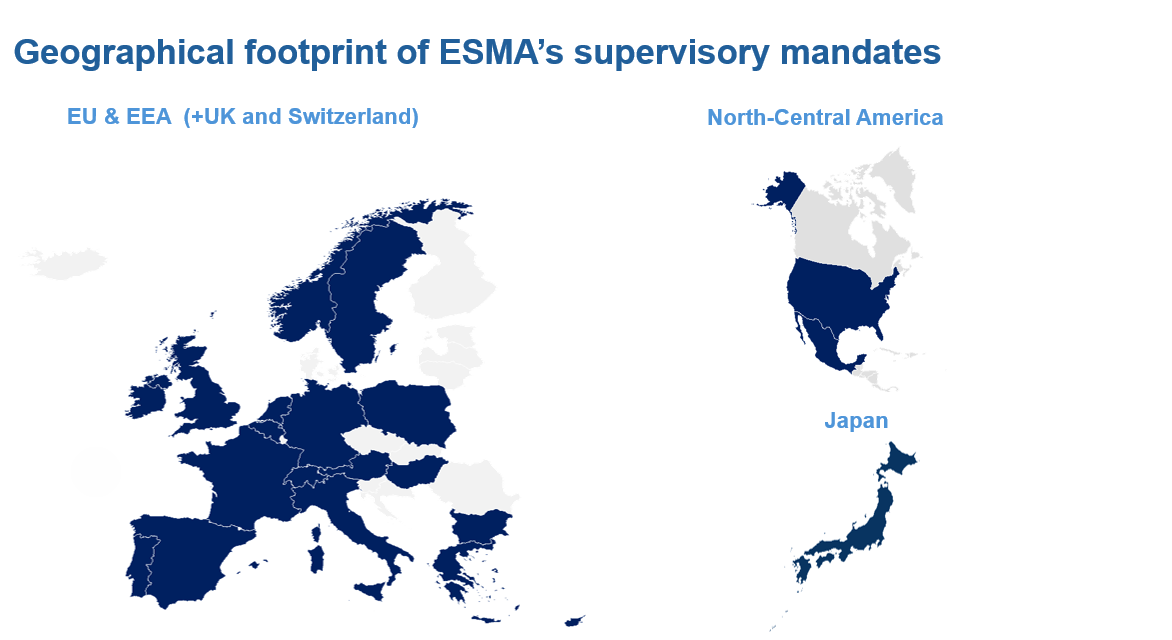
As of March 2026, ESMA supervises a diverse set of over 50 entities across 21 countries, ranging from small specialised firms to large players belonging to global groups active across regions. Through supervision of some of the Europe’s largest financial entities, ESMA has built supervisory expertise in critical market infrastructures. This supervisory footprint enables ESMA to adapt its approach to different geographical, business and risk profiles.
Our supervisory responsibilities
We supervise firms through on-going engagement, thematic reviews, onsite inspections, risk assessments, enforcement actions.

Credit Rating Agencies (CRAs): ESMA registers and directly supervises CRAs across the EU. Our supervision aims to ensure that credit ratings are independent, objective and of high quality. ESMA reviews how CRAs govern themselves, develop and apply methodologies, manage conflicts of interest and comply with regulatory requirements.

Trade Repositories (TRs) under EMIR & SFTR: ESMA authorises and supervises TRs that collect derivatives and securities financing transaction data. Our supervision aims to ensure data quality and complete reporting so that authorities can rely on the data for market monitoring. ESMA also oversees the repositories’ operational resilience to ensure continuous and secure data availability.

Securitisation Repositories (SRs): ESMA registers and oversees SRs that receive and publish securitisation disclosure data. Our supervision aims to ensure that data is accurate, accessible and timely so investors and authorities can assess risks.

Benchmark Administrators (selected scopes): ESMA directly supervises EU critical benchmark administrators and acts as the single-entry point for third‑country benchmark administrators in the EU. Our supervision aims to ensure that benchmarks are governed soundly, built on reliable methodologies and disclosed transparently so that the market participants can trust the integrity of the benchmarks they use.

Data Reporting Services Providers (DRSPs): ESMA registers and supervises Approved Publication Arrangements (APAs) and Approved Reporting Mechanisms (ARMs), which publish trade data and report transaction details. Our supervision aims to ensure that the trade information is published correctly and transaction reports sent to national authorities and to ESMA are complete, accurate and reliable so markets remain transparent.

Systemically important third‑country CCPs (Tier 2 CCPs): ESMA supervises third‑country CCPs of systemic importance for the EU or for one or more of its Member States. This involves ensuring they comply with relevant EU regulatory requirements and cooperating closely with foreign supervisors. ESMA oversees how these CCPs manage risks, such as credit, liquidity, and operational risk to keep them safe and reliable for EU financial stability.

Consolidated Tape Providers (CTPs): ESMA is responsible for running the selection procedures and then authorising and supervising CTPs to deliver high‑quality, consolidated market data tapes. This aims to ensure that market information is accessible to compare and use, supporting fairer and more efficient markets across the EU.

External Reviewers under the EU Green Bond Regulation (EUGB): ESMA authorises and supervises external reviewers that assess EU Green Bond alignment. The mandate aims to ensure that the reviews are credible and comparable to support trust in the EU Green Bond label and prevent greenwashing.

ESG Rating Providers: ESMA authorises and supervises ESG rating providers. The mandate aims to ensure that ESG ratings are transparent, avoid conflict of interest and that investors can rely on the information they provide.
How ESMA’s supervision is funded
ESMA’s supervision is funded through fees paid by the supervised entities. The fees are collected directly from the entities we oversee reflecting the costs associated with their supervision.
The budget break down for 2026 is available here.
15 years of EU level supervision – key milestones
Since its formation in 2011, ESMA has developed its supervisory approach, skills and capabilities. It has invested in understanding the industries it supervises and introduced tools and methodologies to monitor, review and address risks and issues, thus contributing to the smooth functioning of EU capital markets.

Since its creation, ESMA’s supervisory remit has expanded from overseeing just Credit Rating Agencies to a growing range of market participants, encompassing a variety of sectors.

ESMA has directed supervised firms to stop or correct deficient practices by implementing targeted remedial action plans. This constructive approach has addressed identified shortcomings within an agreed timeline, improving compliance and supervisory outcomes.

Since ESMA was granted direct supervisory and enforcement responsibilities, as of March 2026, there have been 21 investigations carried out by ESMA’s Enforcement Unit, leading to 27 enforcement decisions. These investigations have resulted in the imposition of fines on supervised entities amounting to over EUR 18 million.

During Brexit, ESMA worked to safeguard financial stability by delivering the recognition and enhanced oversight of systemically important UK CCPs active in the EU.

Since the recognition of two UK CCPs as Tier 2 CCPs, and as of March 2026, ESMA has carried out four annual review assessments, validated numerous changes to their risk models and parameters, and conducted two CCP stress test exercises covering both EU and Tier 2 CCPs to ensure that any risks they could pose to the EU financial stability are identified and addressed.

Amid Covid-19, ESMA activated its crisis management framework, treating the pandemic as a critical market situation and utilised the emergency instruments under its mandates. ESMA maintained effective supervision of the entities during the pandemic, ensuring continuity of oversight and addressing the market stress.

Following the LIBOR and Euribor manipulation scandals, the EU introduced the Benchmarks Regulation, which has since evolved to strengthen EU‑level supervision. Over the years, ESMA progressively onboarded supervisory responsibilities, culminating in a framework that centralises supervision of EU critical benchmarks and establishes a single-entry point for all third‑country benchmarks in scope of the Regulation.

ESMA has required strengthened governance and internal control frameworks of the entities it oversees. By focusing on the “tone from the top” and reinforcing firms’ risk and compliance functions, ESMA helped ensure that internal lines of defence are effective before risks materialise and cause harm to investors or EU citizens.